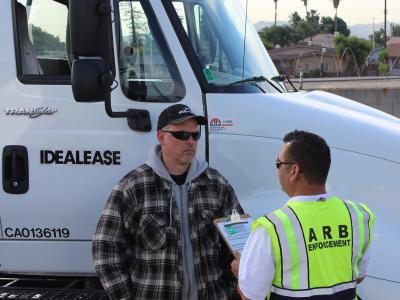


School Bus Idling Airborne Toxic Control Measure
This page last reviewed December 22, 2009

The California Air Resources Board (ARB) has approved an airborne toxic control measure (ATCM) that limits school bus idling and idling at or near schools to only when necessary for safety or operational concerns. The ATCM is effective as of July 16, 2003.
The ARB is authorized by the California Health and Safety Code, Division 26 (Air Resources), to adopt regulations to protect public health and the environment through the reduction of toxic air contaminants (TACs) and other air pollutants with adverse health effects. The ATCM to limit idling is intended to reduce diesel exhaust particulate matter and other TACs and air pollutants from heavy-duty motor vehicle exhaust. The ATCM is a high priority because children riding in, and playing near, school buses and other commercial motor vehicles are disproportionately exposed to pollutants from these sources. Generally, children are more vulnerable than adults to air pollutants because they have higher inhalation rates, narrower airways, and less mature immune systems. Please see Additional Information below to subscribe to the School Bus Idling List Serve or to contact staff.
Applicability
The ATCM applies to school buses, transit buses, school pupil activity buses (SPABs), youth buses, general public paratransit vehicles, and other commercial motor vehicles.
The ATCM requires a driver of a school bus or vehicle, transit bus, or other commercial motor vehicle to manually turn off the bus or vehicle engine upon arriving at a school and to restart no more than 30 seconds before departing. A driver of a school bus or vehicle is subject to the same requirement when operating within 100 feet of a school and is prohibited from idling more than five minutes at each stop beyond schools, such as parking or maintenance facilities, school bus stops, or school activity destinations. A driver of a transit bus or other commercial motor vehicle is prohibited from idling more than five minutes at each stop within 100 feet of a school. Idling necessary for health, safety, or operational concerns is exempt from these restrictions.
In addition, the ATCM requires a motor carrier of an affected bus or vehicle to: ensure that drivers are informed of the idling requirements, track complaints and enforcement actions, and keep records of these driver education and tracking activities.
On December 12, 2002, the Board approved the ATCM with modifications to clarify that:
- the measure does not apply to heavy-duty vehicles used solely as private passenger vehicles
- the idling exemption to operate equipment is to ensure safety or health, or otherwise required by federal motor carrier safety regulations
- California Highway Patrol officers are a subset of peace officers and that there are designees of peace officers who are authorized to enforce certain laws as peace officers; and
- refuse pick-up is another example of an idling exemption to accomplish work for which a vehicle was designed.
The EPA's Clean School Bus USA program announced a new video designed to train school bus drivers and pupil transportation officials on how reduced engine idling can improve the health of students and save money by cutting down on fuel costs. The five-minute video is available free of charge from the National Service Center for Environmental Publications (NSCEP). Phone orders can be placed by calling (800)490-9198 or (513) 489-8190. Business hours are Monday through Friday, 7:30 a.m. - 5:30 p.m. (EST). After hours you may leave a voice mail order. The web address for information and links for ordering is http://www.epa.gov/ncepihom/ordering.htm. You may also e-mail ncepimal@one.net to request publications.
The final rulemaking package was approved by the Office of Administrative Law (OAL) on June 16, 2003, and filed with the Secretary of State. The ATCM became effective as of July 16, 2003.
|
Board Update on Implementation and Compliance |
October 28, 2004 In-Person |
|
|
ATCM in Effect |
July 16, 2003 Regulation
Printed in California |
|
|
ATCM Approved |
June 16, 2003 OAL
Approved ATCM and Filed |
|
|
Final Rulemaking |
May 15, 2003 OAL Package Sent |
|
|
Proposed Modifications Comments Due By
|
March 7, 2003 Notice
of Proposed |
Notice
of Availability of |
|
Board Adoption Hearing |
December
12, 2002 |
Public
Hearing Notice: Word,PDF |
|
Please
use the following link to view The Staff Report: Initial Statement of
Reasons (ISOR) |
||
|
Public Workshop |
September 12, 2002 |
|
|
Public Workshop |
September 10, 2002 |
|
|
Public Consultation Meeting |
July 23, 2002 |
|
California's Diesel Risk Reduction Plan
Children's Environmental Health Protection Program
What You Should Know About Reducing Diesel Exhaust From School Buses
U.S. EPA's Diesel Exhaust Site-Health Effects
EHHI's Diesel Exhaust and Children Site
Children's School Bus Exposure Study
Diesel Fuel Program
Lower-Emission School Bus Program
Mobile Source Programs Related to Diesel Engines
School Bus Idling ATCM Rulemaking Project Profile
KnowZone
Enforcement Advisory 318: Limit School Bus Idling and Idling at Schools
News Release - Cleaner Air at California Schools: Bus Idling Restrictions Now Enforced
How do I Report an Idling Violation?
You can use any of the following options to report an idling violation:
- Call the Air Resources Board at 1-800-END-SMOG (1-800-363-7664)
- Submit an online complaint
- Contact your local air pollution control or air quality management district.
For more information regarding the ATCM to Limit School Bus Idling and Idling at Schools, please contact Nancy O'Connor at (916) 322-8325.
School Bus Idling List Server - You can subscribe or unsubscribe to the ARB School Bus Idling and Idling at Schools List Serve created to notify interested parties about changes to this website.