
7.3. Fuel Mix Update for Greenhouse Gas Emissions#
Starting in EMFAC2017, the CO2 emission rates under the GHG module are estimated based on the complete combustion of transportation fuels, consistent with the official CARB, U.S. EPA, and IPCC methodologies. Complete combustion means that a fuel is burned completely, and all carbon content of the fuel is eventually converted to CO2. This approach disaggregates fuel blends into major components, and thus, CO2 emissions from each of the fuel components are calculated individually. Total CO2 emissions are simply the sum of those from each component. The fuel blend component approach recognizes the increasingly important role of biofuel combustion (ethanol, biodiesel, renewable diesel, etc.). It also allows for the inclusion of future emerging fuel components in a fuel blend and for tracking in upstream analysis. This aligns with the methodology used for CARB’s official GHG inventory. Equation (7.3) describes how CO2 from each component of a fuel blend (e.g., gasoline or diesel) is calculated. This equation also applies to natural gas vehicles, and natural gas is measured in standard cubic feet (scf) instead of gallons.
where
CO2: CO2 emissions of gasoline (or diesel) vehicles for a particular vehicle type (grams).
Fuel Consumption: Fuel consumption for a particular gasoline (or diesel) vehicle type (gallons). The fuel consumption is calculated from the emission modules in EMFAC for both light-duty and heavy-duty vehicles.
Blend Proportion: The volumetric proportion of the component in the fuel blend (%).
CO2 Emission Factor: CO2 emission factor by combustion of the fuel component, assuming complete combustion (grams CO2 / BTU). The current CO2 emission factors come from CARB’s Mandatory Greenhouse Gas Reporting Regulation (MRR) (CARB, 2012).
Heat Content: Heat content of the fuel component; i.e., annual average higher heating value (HHV) of the fuel component (BTU/gallon). The current heat content values come from CARB’s Mandatory Greenhouse Gas Reporting Regulation (MRR) (CARB, 2012) based on the average HHV.
For fuel blend composition, the previous EMFAC versions used fuel blend information from the California Board of Equalization (BOE), which provides volume data for total gasoline blend, total diesel blend, biodiesel, and renewable diesel sold in California. In EMFAC2025, the fuel blend data were updated using the quarterly report from the Low Carbon Fuel Standard (LCFS) regulation, which was approved in 2009 and began implementation on January 1, 2011. The LCFS is designed to encourage the use of cleaner low-carbon transportation fuels in California, encourage the production of those fuels, and therefore, reduce GHG emissions and decrease petroleum dependence in the transportation sector. Under the LCFS, all regulated entities must report transportation fuel transactions and credit transfers to CARB. Specifically, the latest LCFS Quarterly Data Summary from 2025 Q3 is used to update the fuel blend between calendar years 2011 and 2025, and the fuel blend after 2026 is carried over from 2025. With this update, two renewable fuel types were introduced as new fuel components, including renewable fuel and renewable gasoline.
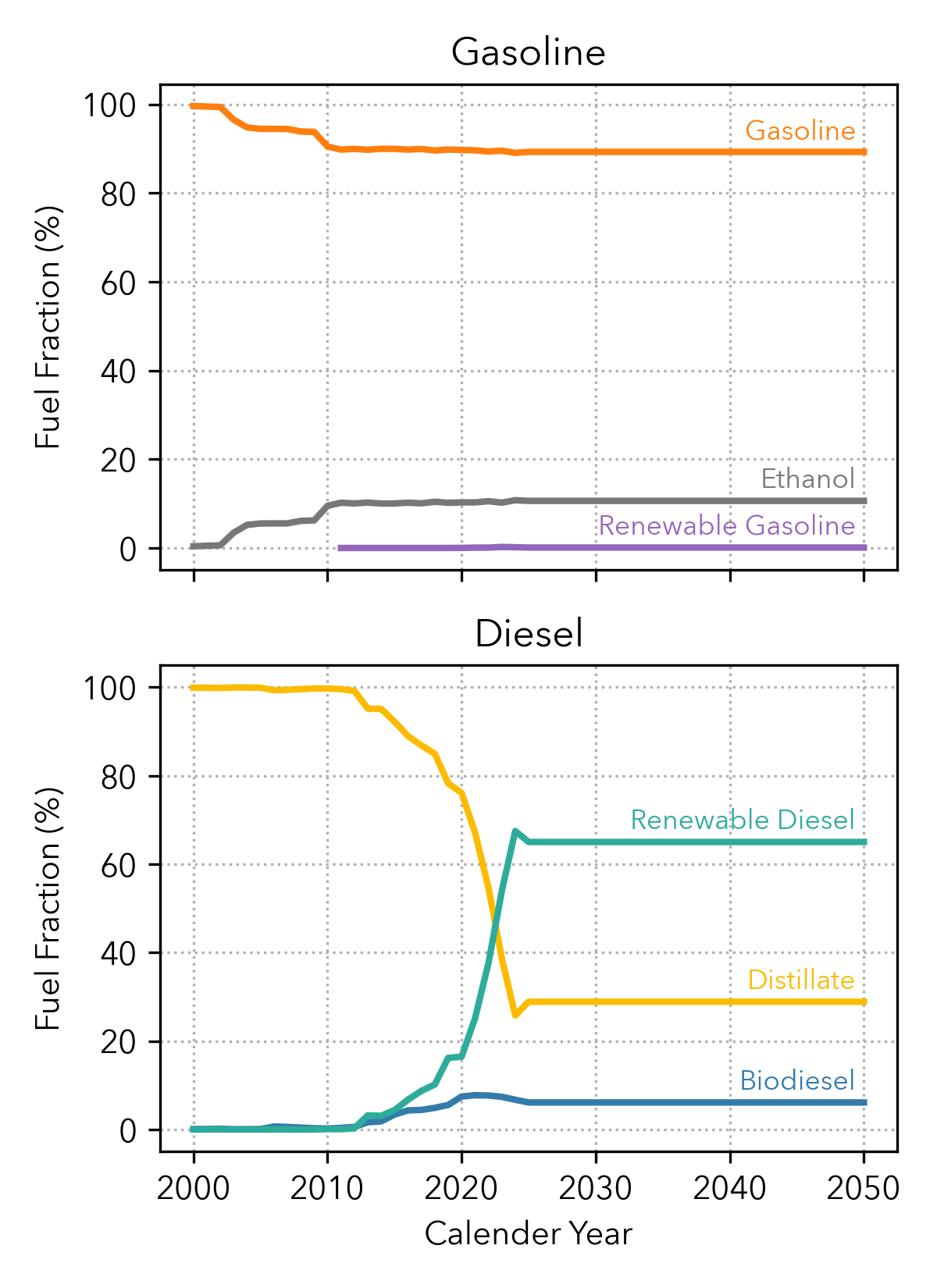
Figure 7.10: EMFAC2025 Fuel Blend by Calendar Year and Fuel Type#
Based on Figure 7.10, the proportion of renewable diesel in diesel fuel grows substantially since the LCFS start, while renewable gasoline is introduced more recently and contributes to less than 1% of gasoline fuel by 2025. The natural gas is composed of a single fuel source, and plug-in hybrid vehicles share the same fuel blend as gasoline vehicles. Therefore, those fuel types are not plotted. The growth of those alternative fuel types can have potential implications on GHG emissions and should be accounted for going forward. Moreover, the LCFS quarterly report also provided heat content for various fuel components based on lower heating values (LHVs), including renewable gasoline and diesel. Therefore, it is used to generate heat content for renewable fuels using HHV from MRR and the relative ratio between renewable fuels and their conventional counterparts. Specifically, the heat content of renewable gasoline is 2.4% higher than the conventional California gasoline blend, and the renewable diesel is 3.5% lower than distillate diesel fuels based on LCFS data. The CO2 emission factors of renewable fuels are estimated from the emission factors from conventional fuels due to a lack of data, and will be updated in future versions if data becomes available.